Lure catalog / Prop Baits
L.08Prop Baits
Prop Baits
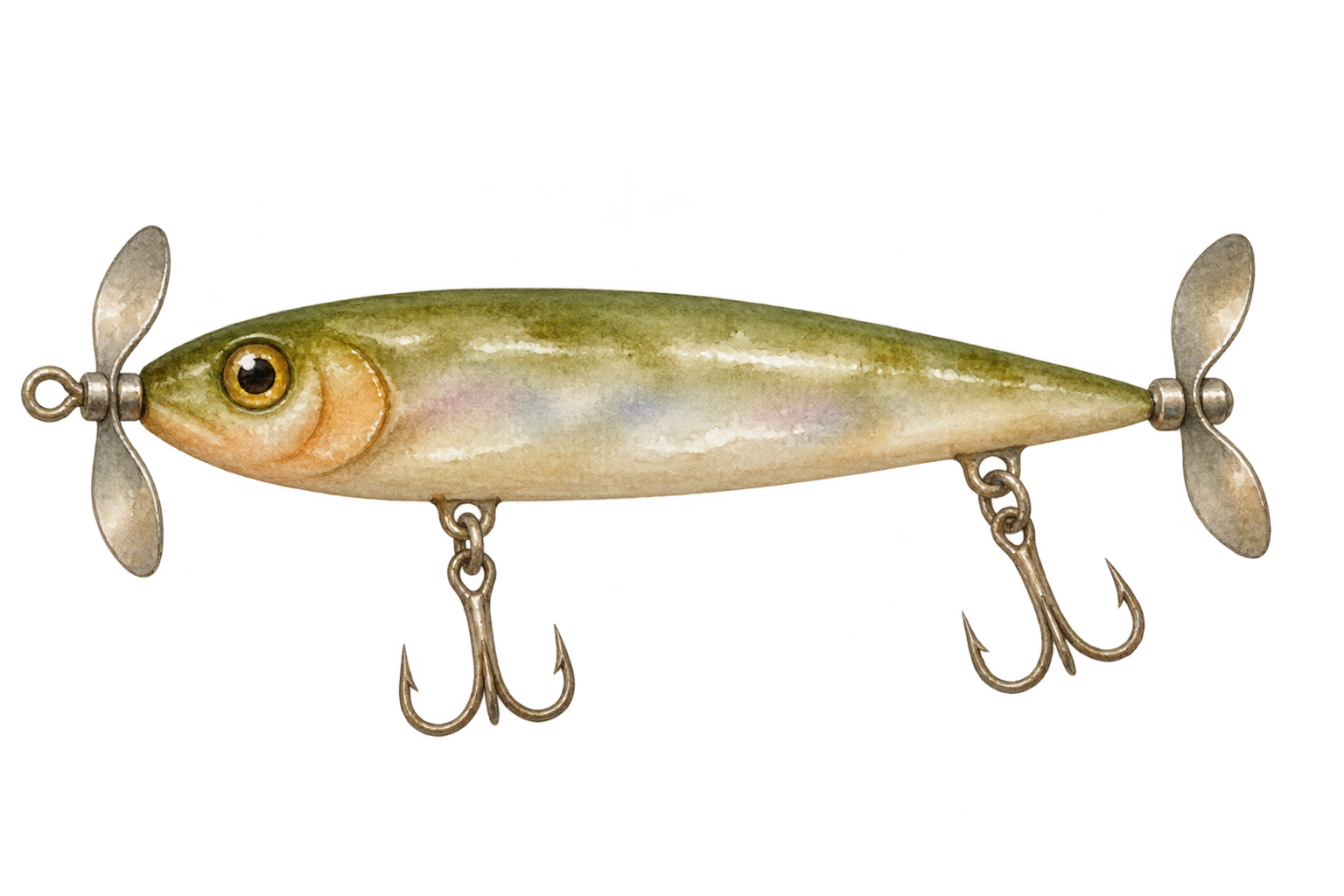
Body-mounted propellers disturb the surface and leave an audible wake.
Shape and identification
PRESENTATION
- Buoyancy
- Floating models in this entry
- Working layer
- Surface, at a speed that engages the propeller.
- Example size
- 60–120 mm
- Example weight
- 7–30 g
- Tackle notes
- Keep line and hardware clear of the front propeller and test before fishing.
01Use & Limits
Use and limits
When & Where
Open grass edges and shallow bays where surface disturbance is useful.
Limits and common errors
Fine weeds foul propellers; this is not a frog for thick mats.
02Retrieve
Retrieve steps
- Find the speed that turns the propeller reliably.
- Retrieve steadily along clear edges or use short pulls with pauses.
- Clean fouled blades rather than continuing with impaired action.
AMotion & Structure
Motion and structure
Structure illustration
Action Demo
- The props spin on the retrieve, churning the surface into spray, noise and a visible wake.
- On rotating-tail models the whole tail spins, making more noise and staying visible even in choppy water.
BTackle & Technique
Tackle and technique
- Rod
- M–MH, moderate-fast or fast
- Reel
- Baitcaster or spinning
- Line
- Mono or braid
- Steady, medium-speed retrieve to keep the blades turning.
- Prop models can also be fished snap–pause, each snap giving a burst of noise.
- Rotating-tail models tend to twist line; add a swivel or use a baitcaster.
More application notes
- Summer and fall, when fish are active
- Choppy water (the noise is easier to hear)
- Weed edges, shallow flats
- Lots of floating debris (it tangles in the blades)
04Targets
Target examples
Target links are starting points; match the model to fish size, depth and cover.
REFReferences
References and scope
- Take Me Fishing / RBFF · Freshwater Fishing Lures ↗
An introduction to hardbaits, plastics, spoons and rotating-blade lures.
- Vermont Fish & Wildlife · Poppers and Walking-Style Baits ↗
Popper and walking-bait actions and handling surface strikes.