Lure catalog / Skirted Bottom Jigs
L.16Skirted Bottom Jigs
Skirted Bottom Jigs
A weighted hook, skirt and trailer for bottom presentations; this entry does not represent every jig.
Shape and identification
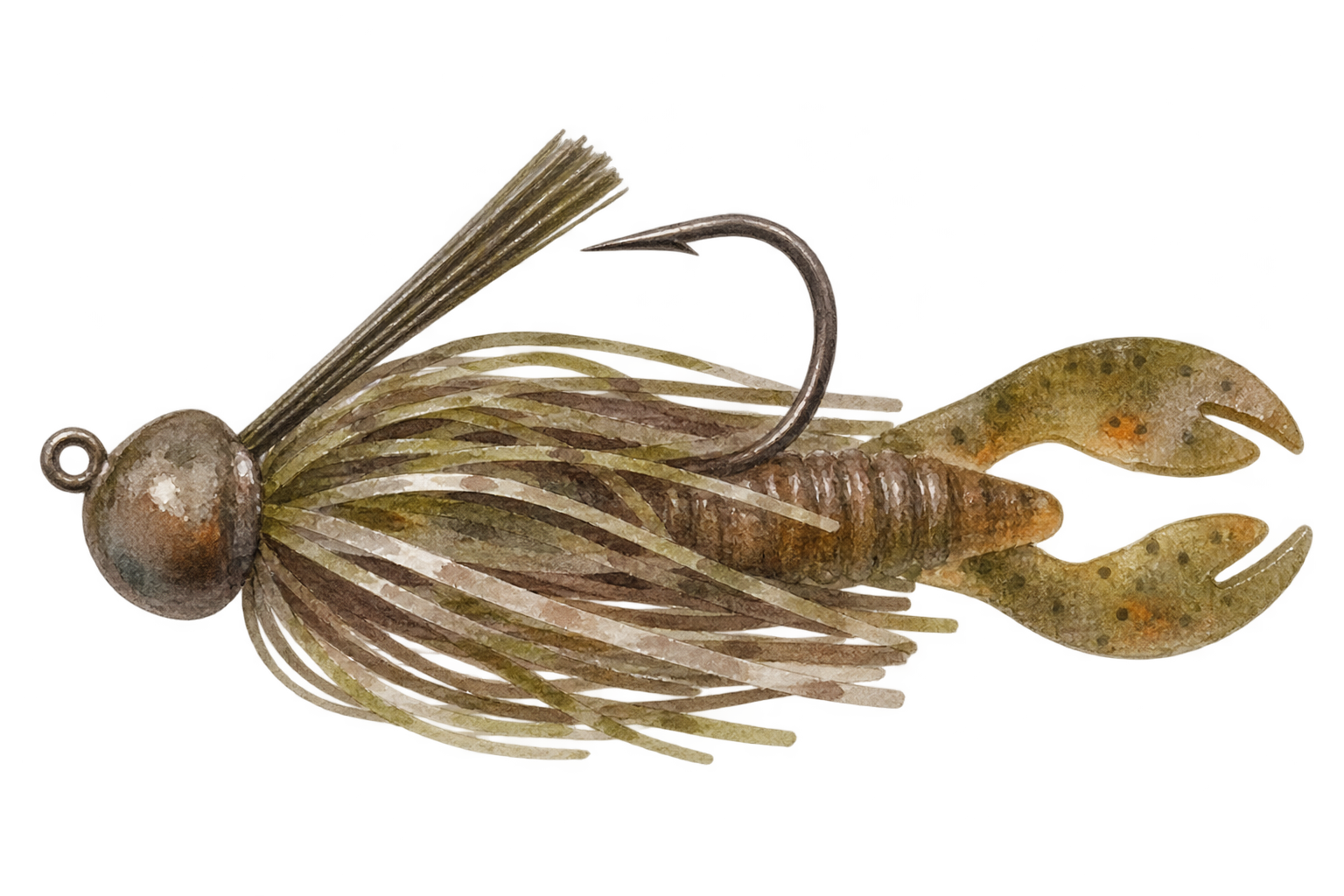
PRESENTATION
- Buoyancy
- Sinking; the trailer influences the fall
- Working layer
- Mainly worked in bottom contact, with weight adapted to depth and cover.
- Example size
- Trailer 50–100 mm
- Example weight
- 5–21 g
- Tackle notes
- Use a sensitive rod with enough power for the single hook and line suited to cover.
01Use & Limits
Use and limits
When & Where
Rock slopes, isolated wood, dock shade and cover edges.
Limits and common errors
A weedguard is not snag-proof; a shaky head is a separate softbait-head combination.
02Retrieve
Retrieve steps
- Control the entry and fall and watch for unusual line movement.
- Hop briefly or drag slowly after contact without rushing out of the strike zone.
- Recover slack when weight is felt, then set firmly.
AMotion & Structure
Motion and structure
Structure illustration
Action Demo
- The weed guard sits in front of the hook point; when it hits branches or rocks it bends first, so the hook slides over the obstacle.
- The skirt flares and pulses on the fall and the pause, and with the trailer it imitates crawfish and crabs.
- Head shape sets the use: round heads for general bottoms, football heads for dragging over gravel, bullet heads for punching through weeds.
| Type | Notes |
|---|---|
| Casting / hopping jig | The most versatile style, for dragging and hopping. |
| Football jig | The wide, flat head rocks side to side as it's dragged over rock and rarely wedges into cracks. |
| Flipping / punch jig | A heavy, bullet-shaped head for getting into holes in the weeds and inside wood. |
| Swim jig | A fish-shaped head, swum on a steady retrieve with a paddle-tail trailer. |
BTackle & Technique
Tackle and technique
- Rod
- MH–H, fast or extra-fast, 7'0"–7'6"
- Reel
- Baitcaster, high gear ratio
- Line
- Fluoro 14–20 lb; PE #3–5 in weeds
- Hopping: lift the rod tip 30–60 cm to hop the jig off the bottom, let it fall back, reel up slack and repeat.
- Dragging: slowly sweep the rod sideways so the jig crawls along the bottom, pausing when it hits cover.
- Precise presentations (flipping / pitching): quietly drop the jig into cover at close range and let it fall straight down.
- Most bites come on the fall: if the line suddenly stops sinking, jumps or moves sideways, reel up slack and set the hook right away.
- Set the single hook hard; the point has to get past the weed guard before it can penetrate.
More application notes
- Heavy cover such as wood, rock piles, docks and holes in the weeds
- Fish holding on the bottom, unwilling to chase, or cold water
- Targeting big fish
- Open water with no structure
04Targets
Target examples
Target links are starting points; match the model to fish size, depth and cover.
REFReferences
References and scope
- Vermont Fish & Wildlife · Jigs ↗
Skirted, hair and soft-plastic jigs; jig fishing is not limited to vertical hopping.